
There is
no one free from weakness;
no one without a load to carry;
no one who is self-sufficient;
no one who can dispense without another’s help.
And so, it is our duty: to comfort each other.
to help, to guide, and advise each other.
no one free from weakness;
no one without a load to carry;
no one who is self-sufficient;
no one who can dispense without another’s help.
And so, it is our duty: to comfort each other.
to help, to guide, and advise each other.
Imitation of Christ, Book 1, XVI, 50

Mother Mercy Hospital, Gidel Sudan
In 2009, Mother of Mercy Hospital was established as a Catholic hospital to serve the impoverished people of the Nuba Mountains in southeastern Sudan. Dr. Tom Catena, a legendary Family Physician, has been serving there since the beginning. “Dr. Tom” is a dynamo. He covers everything, pediatrics, maternity, and surgery 24/7, with the energy of a man who is where he is supposed to be, doing what he has been made to do. He is revered by everyone, and it is well deserved. I had the honor to work side-by-side with him for a short time. Yes, he truly is a great man. He’s everything I’ve heard he was.

I went there to cover for him. Dr. Tom had temporarily gone to the USA to fund raise. Mother of Mercy, being a Catholic hospital, gets no financial support from Sudan’s Islamic government. What keeps this hospital running is Dr. Catena’s network and strong fund-raising efforts.
Fortunately, I arrived with a Family Physician, Dr. Stephen Reaney, from Northern Ireland. He’s quite a story himself. He and his Family Physician wife, Kate, raised their children as medical missionaries in Tanzania for over 10 years. Kate stayed back in Ireland during this trip. I learned a lot from him about tropical medicine. Dr. Reaney and I worked hard to be the equal of one Dr. Catena.

Camping out at Mother of Mercy Hospital
Working at Mother of Mercy Hospital reminded me of going on a summer camp out.
Temperatures were in the 100s, with no air conditioning, no fans and only warm water to drink.
Power was limited. All electricity came from solar panels. Internet was non-existent for most of my time there. A rare rainstorm damaged the wiring.
Temperatures were in the 100s, with no air conditioning, no fans and only warm water to drink.
Power was limited. All electricity came from solar panels. Internet was non-existent for most of my time there. A rare rainstorm damaged the wiring.
We used outhouses. It was so dark at night that during my first few nights there I would get lost trying to find my way back! The hospital was dark too. Lightbulbs were in short supply. The hospital’s light bulbs were burning out and there was no place locally to buy replacements.
The hospital is quite isolated. It is surrounded by miles and miles of dry rocky hills.
My little joke to myself was that if the hospital was a prison, it would not need walls.
There’s literally no place to go. All the more important that the hospital is where it is.

The UN Airlines and the Yida Refugee Camp
There’s no easy way in or out. It takes about 4 days to get there. I never knew that the United Nations ran an airline to move relief workers and missionaries around that area of the world. Their plane took me from Juba, the capital of South Sudan, to the Yida Refugee Camp, after a stop in the town of Rumbeck. The refugee camp is a remnant of the religious conflict that split Sudan and created South Sudan. It has been there for years. They are trying to slowly down-size it. My lasting memory of my night in the refugee camp was the mango that I was carrying in my bag. A rat sneaked in and ate it!

Goats rule
The local critters were mostly domestic farm animals: goats, pigs, cows and ducks. They roamed everywhere on the hospital grounds and the town’s streets. It was never clear who owned which animal. The goats were the most numerous. They were free to walk everywhere. If we didn’t close our front door, the goats would be in our dining room and bedrooms. They would eat any green plant within their reach.
Evidence of war
There has been conflict between Christians and Muslims in this area of the world for hundreds of years.
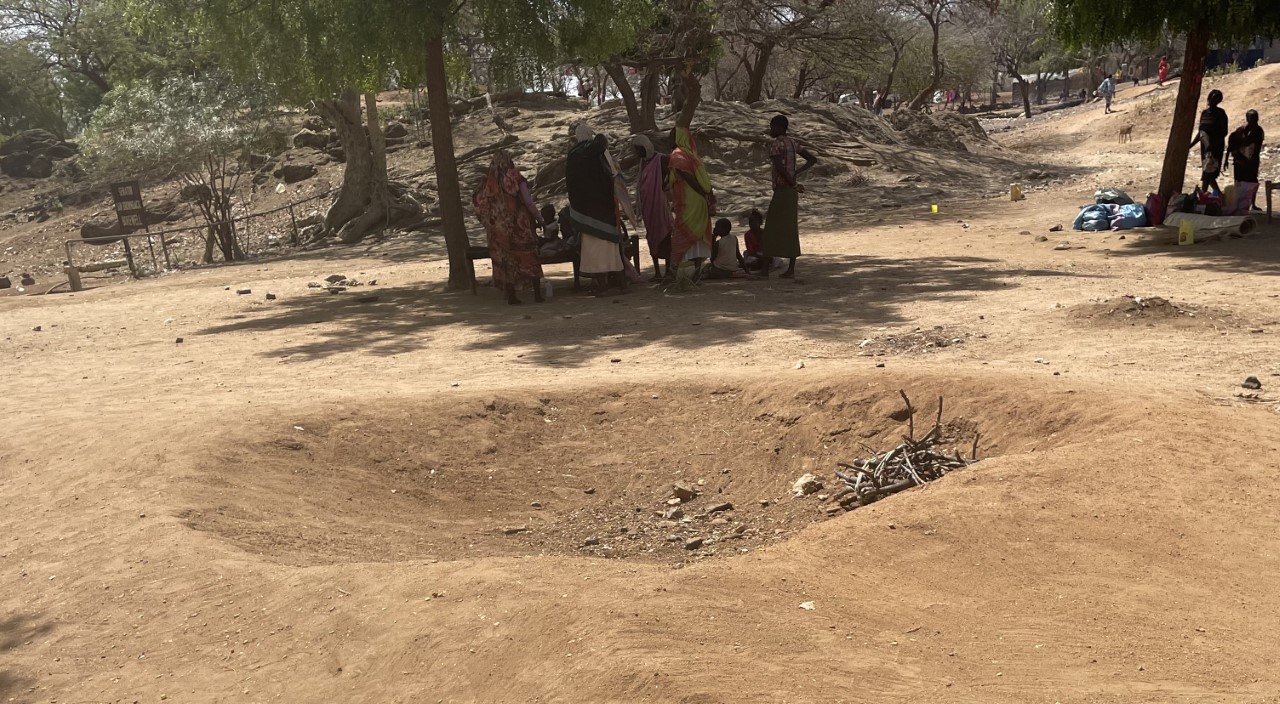
A few years ago, the hospital itself was periodically bombed with cluster bombs by the Islamic government forces. Dr. Tom has a box in the minor surgery room full of metal shrapnel that he has removed from people. Scattered around the hospital campus, there remain small circular craters, called “fox-holes”. People would lie flat in them, below ground level, to escape the detonation of cluster bomb shrapnel sent 360 degrees in all directions. My own bedroom had a large crack in the concrete floor and wall from a bomb that went off nearby. The bombing stopped several years ago. The locals aren’t sure that it's permanently over with. It was a rare honor to go to Mass on Sundays with other Christians who had actually faced physical persecution for their faith.
A few years ago, the hospital itself was periodically bombed with cluster bombs by the Islamic government forces. Dr. Tom has a box in the minor surgery room full of metal shrapnel that he has removed from people. Scattered around the hospital campus, there remain small circular craters, called “fox-holes”. People would lie flat in them, below ground level, to escape the detonation of cluster bomb shrapnel sent 360 degrees in all directions. My own bedroom had a large crack in the concrete floor and wall from a bomb that went off nearby. The bombing stopped several years ago. The locals aren’t sure that it's permanently over with. It was a rare honor to go to Mass on Sundays with other Christians who had actually faced physical persecution for their faith.

Conflict: tough on patients and ordinary people
Sudan’s Islamic state doesn’t support the Catholic Hospital. Imported supplies to support the hospital’s Pharmacy and food programs for the local people cannot come through Port Sudan on the Red Sea. They have to come by longer and more circuitous routes.
Sometimes we had patients with serious diseases that needed specialized treatment that we could not give. Sending them to the capital in Khartoum was not possible. For instance, we had several children with retinoblastoma, a condition that is easily curable with radiation treatment. No radiation therapy was possible at Mother of Mercy and referral could not be done.
I’ve never run into these kinds of problems before.

Incredible people
The hardships and the lack of comforts would be enough for many people to never want to live and work in places like Sudan. Then, on the other hand, there are a handful of others who go there to work there precisely because of the hardships, poverty, and the great needs of the people.
There is a joy to serving God through his people where-ever we are. But for these missionary doctors, nurses and relief workers, serving in tough locations makes their joy greater and more impactful.


