Monday, May 8, 2023

Mbingo Baptist Hospital: One of Cameroon’s Finest

"Act, and God will act."  

                            St. Joan of Arc


At first glance, it’s easy to underestimate Mbingo.

It’s surrounded by beautiful mountains, green hills, and distant waterfalls.

And somehow, there’s a 300-bed hospital wedged into it all.  The mission compound is huge.  There are homes for all the members of the nursing and hospital staff.   There are primary and secondary schools for their children.  There’s even an old unused grass-covered airstrip at the perimeter.


It is a referral center and a training center.  There are residency training programs in Internal 

Medicine and General Surgery.  There are specialist surgeons in Orthopedics, ENT and Pediatrics.

There are training programs in Physical Therapy and Laboratory Technology.  

In 2017, they installed a CT scanner.  Presently, they are constructing a linear accelerator for radiation therapy to treat cancer.  It’s quite a place.  Hiking in the local hills at 4500- 5000 feet is the favorite extra-curricular activity.


Inspirational returning physicians


People like coming to Mbingo.  Many physicians keep coming back each year, each selflessly adding their expertise.  There’s the Chief of ENT at Mt. Sinai in New York City; a Head and Neck Surgeon from Johns Hopkins in Baltimore; and a Chief of General Surgery at St. Luke’s in Philadelphia.  All of them will bring along their wives and young residents in training.  From Canada, comes an Emergency Medicine physician who has been coming for the last 10 years.  An Ontario Gynecology-Oncologist comes twice a year.  The list goes on, with physicians from Oregon and Minneapolis too.  And I must mention the ‘long-term’ medical volunteers, who really help keep the place running.  They come from the USA, Canada and Australia.  It is quite inspiring to see and to be a part of.  Go to the missions and meet the world!


The residency training programs


Mbingo produces good physicians.  More and more of them are taking charge of the hospital care and administration.  It’s exactly what should be happening.  It is wonderful to see the camaraderie and spirit among them.  They are much like the residents that I’ve trained in the USA.  They are the light of Africa’s future.  That’s why it’s so important to help them.


The amenities


Even though it looks like one is far from everything, the accommodations are good.  I’ve even had my own washing machine and refrigerator. The Cameroon Baptist Convention (CBC) is well organized. Mbingo Baptist has come a long way from its beginnings 70 years ago as a Leprosy Hospital.


Mbingo’s Weaver Birds

I love them.  The sounds of Mbingo are the songs and trilling of the beautiful yellow breasted weaver birds, who seem to live in most of the trees around campus.  They are everywhere and quite tame.  Walking around, I try to give them space as they hop around the small market area within the hospital grounds, looking for food.


The Goats do NOT rule


Agriculture is the main economic activity here.  Farming is always going on somewhere, even on campus.  The maverick out-of-control goats who go into the fields and eat the crops of the local farmers are not appreciated.  Evidence of that is seen in this message went out on the mission community bulletin board:

“Greetings dear colleagues,

We are calling on all of us who have goats or know someone with stray goats to constrain them or the goats shall be caught and auctioned.

By Tuesday March 21, 2023, if your goat is found straying, 

we will catch it and slaughter it for you.

Let the information be spread to the people not in this forum.”


The community bulletin board of WhatsApp


WhatsApp is used  for communication in the form of a community bulletin board among the Mbingo missionary volunteers both near and far.  People share and keep up with their daily struggles and worries.  We hear about the health of the missionaries themselves and of their elderly parents back home.  Sometimes, missionaries return home.  I felt their closeness and felt part of this wonderful community of good people.  


Singing at Worship Services


Song is very much a part of all African Christian worship.  They say that if you sing, you pray twice.

I’m not very good at it, but the Africans sure are.  Their harmonizing and their side-to-side dance movements during services are something that we all could sure use back home.  I guess I should stop being so self-conscious and just go for it like the Africans do.


The Cameroonian Civil War and the “Mbingo Bubble”


What spoils all of this is a chronic smoldering civil conflict in the background.  Its origins can be traced back to the end of World War I when Cameroon was a German colony.  When Germany was defeated, France and England split Cameroon between themselves, creating a French-speaking section and an English-speaking section.  That flawed setup has led to today’s fighting.  The English-speaking section wants independence.  They want to call their new country “Ambazonia”.  Thus, their small, scattered guerilla forces are called the “Amba” or “the boys”.  They are loosely controlled.  They do what they can to disrupt the province, occasionally closing roads, and extorting ‘ransom’ money from road travelers.  Most local people seem tired of the whole business.


Still, the hospital, its volunteers, and staff are safe.  It is a protected space because it serves everyone (the Mbingo bubble).  Visiting physicians are safe because they generally rarely leave the hospital compound while on mission.  Life goes on and the common people still make their way to the hospital for help, though in fewer numbers than 10 years ago.


I’m learning to be less envious and jealous of others.  


Instead, I’m learning to marvel at other’s successes.  I’m learning to appreciate how God’s power is working through them.  But I shouldn’t worry or be bothered about what God’s plans are for others.   

It’s none of my business.  It’s all between them and God.  


God has His plan for me.  And that’s enough.  It’s up to me to focus on that.  I need to take a deep breath and just trust Him.  And then run as hard as I can in the direction that He’s laid out.   

Then I will be doing what I was made for.   And it will be good. God knows what He’s doing.

Tuesday, February 28, 2023

Acceptance Speech: Mgr. Anthony Brouwer’s Award


In all your ways acknowledge Him,

And He will guide your path.

Proverbs 3:5


Thank you, Mission Doctors,

I don’t get awards every day. So, this is a good day.

And the good days balance the bad days.

And I am grateful.


We all want to help each other. We want to help our families,

our children, our parents, our friends and even strangers in need.


When I was younger, I wanted to help others and serve God.

I wanted to make a difference. I wanted my life to matter.


I went to college to become a doctor.

But it wasn’t going very well. I was losing.

I had one really bad semester. Organic Chemistry.

I didn’t get an A. I didn’t get a B. I didn’t get a C. I got a D.

And then all the guidance counselors came out of the woodwork

to tell me that I didn’t have what it took. They said that

I didn’t have the talent and that I should do something else with my life.

Well………. NO!


If we look backwards on our lives,

We can see the pattern of God’s Hand.

Where there is pain, there is often God’s Hand,

directing and molding us.


“And we know that all things work together for good

for those who love God,

to those who have been called according to his purpose.”


Everything happens for a reason.

I did the best I could.

I went to medical school in Mexico.

I tried to learn Spanish.

There were lots of us down there.

At the time, I could not see or understand that

God was at work molding me and shaping me.

But He was.


I remember when I was working in a small Mexican town.

It was hot, dusty and there were many flies.

There were lots of livestock: donkeys, chickens, pigs and goats running around.

I was a student, wearing my white coat, my white pants, my white shirt.

I met up with the local people, with their straw hats and sandals.

And their clothes were faded and over-worn; not designer types.


Then I got a look at where they were living:

adobe huts, brown mud brick, with tiny windows.

There was no electricity and no running water.

They had nothing. I’d never really seen poverty before,

but now I was surrounded by it.


Then a stray idea came to me.

I still wanted to help others and serve God.

I still wanted to make a difference and for my life to matter.

But how? How is that going to happen?

Where can I make the biggest difference?

I looked around.


Maybe I could make the biggest difference,

by going where the need was the greatest;

Going where the need is greatest, to make the biggest difference.


A simple idea.

And that simple idea has ruled my life and

stayed with me for the last 45 years.

And it has never faded.


That’s really it.

That’s why I am standing in front of you this evening.

Nothing more complicated than that.

I’m just trying to do the same thing that you’re trying to do.

just in different places. This is just how it came out with me.


It feels strange to be accepting an award.

Is it a sacrifice to do what I want to do?

Is it a sacrifice to want to serve others;

to be where I am supposed to be, doing what I am

supposed to be doing?


No.

I can’t think of anything else I’d rather be doing.

It’s a joy. It’s not the “jumping up and down” kind of joy.

It’s the peace of mind you have when what you are doing feels right.


Working for God; working with God, through His people.

Playing on the winning team. God gives all of us a jersey and a number to wear.

And He lets us run around the field and run around the earth.


At this time last year, I was in Sudan, at Mother of Mercy Hospital.

It’s an Islamic State. Which means they hate Catholics. They hate Christians.

Incredibly, 3 years ago, the central government was bombing the Catholic Hospital

with cluster bombs, throwing shrapnel and pieces of steel in all directions.

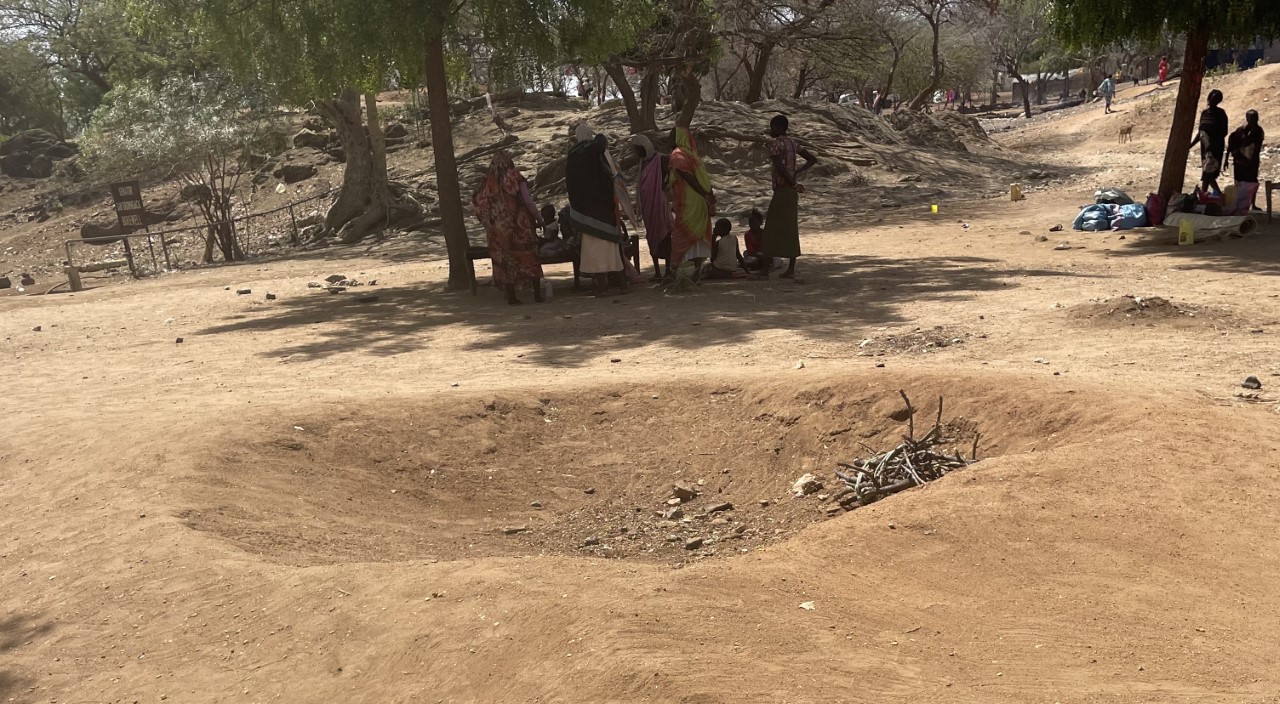
People would throw themselves into holes in the ground to avoid the flying steel.


What is it like to be shoulder to shoulder with people who have been persecuted ?

It’s an honor. Yes. But those people made me stronger: stronger in my faith.

If they can handle being bombed for being Catholic, so can I. So can you.

God doesn’t want a bunch of wimps doing His business.

God made us to be strong.


Here’s a Christmas story. It’s a little out of season, but it fits.

Let’s go to the South Bronx of New York in winter:

Inner-city, fields of rubble, grey skies, shortened days, cold!

Now let’s go to Lincoln Hospital.

The rooms of the patients were dark and cold too.

Patients needed 3-4 blankets to stay warm.

High on the walls, they had those crummy old television sets with lines running across them.

They were sick and cold. They had no visitors. And nobody was coming.


Now switch the spotlight over to my good friends, Mary and Mike.

They’re a power couple like few I’ve seen.

Mary got her MBA from Columbia. Mike got his MBA from Harvard.

They worked on Wall Street, giving financial advice to banks, while I was down in the South Bronx. For some inexplicable reason, they sent me a Christmas present that year:

two boxes of the most exquisite cakes that I’ve ever seen.

The devil’s food cake had about an inch of frosting around it.

And there was blueberry, strawberry, lemon, coconut flavors too. Incredible cakes!

I did not eat them. I took those cakes into Lincoln Hospital and delivered them, one-by-one, to my patients in those cold dark rooms. And they smiled. And it was spectacular and wonderful. It was a good day.


Without Mary and Mike, it would not have been a good day.

I would have had no cake to give anyone.

In a real sense, Mary and Mike were the cake that I was delivering to those people in dark places. And, without you, the Mission Doctors Association and Lay Mission Helpers have no cake either. Without you, Mission Doctors has no cake.

Without you, the missionaries in the field have no cake to give to anyone.

You are the cake. They are giving you to the people in great need.


God has given each of us something good to do.

And it’s great and spectacular to be doing it.

Thank you all for being a part of His team.

I’m proud to be a strong Catholic.


May God continue to bless all of us.

As we all continue to do His work.

Working for God, working with God, through His people.


And we know that all things work together for good

for those who love God,

to those who have been called according to his purpose.

Romans 8:28


Wednesday, November 16, 2022

Bere Adventist: A Front-Line Hospital

"I will go anywhere and do anything in order to communicate the love of Jesus to those who do not know Him or have forgotten Him."

St. Francis Xavier Cabrini


Answering a distress call from Bere Adventist

Dr. Bill Rhodes and his wife Laura have worked for over 25 years in northern Kenya.  Bill is a plastic surgeon and the Chief of Surgery at Kapsoar Hospital.   I met up with them while working in Sudan.  They urged me to go to Chad and fill a need at Bere Adventist Hospital.   They had lost their general surgeon and needed help.  So, I arranged to go there to help them out.


Dr. Bill and Laura

Chad was a surprise.

I expected Chad to be full of rock, sand dunes and furnace-like heat.   But I was wrong. 

I found rice paddies.   It was the rainy season.  The roads were flooded and full of potholes.   When I rechecked the map, I realized that Bere Adventist Hospital was in the extreme south of Chad, away from the desert, close to where 3 countries’ borders come together: Chad, Cameroon, and the Central African Republic.   


I am not Indiana Jones.

Getting to and from Bere Adventist during the rainy season was an interesting trick.

The hospital did not want to risk losing one of their valuable vehicles on the muddy roads. So just before daybreak, I left the guest house and was dropped off at the bus station.  I took a 10-hour bus ride south from Chad’s capital of N’Djamena to the town of Kelo.  Several times during the trip, road-side military units would randomly stop the bus and order all of us out to have our bags checked for weapons.  My fellow passengers had no problem with any of this, so I didn’t either.

Finally, we arrived in Kelo.  What now?  I didn’t have to wait long.  A nice fellow approached me. He identified himself as coming from Bere.  He and his partner loaded my bags and me on two motorcycles. And off we went.  Motorcycles can zig-zag through the mud and around the puddles and potholes.  It was a rough 2+ hour ride.   I didn’t feel like Indiana Jones.  I felt more like a goat, tied to the cycle’s back end on its way to be sold at the market!  My behind hurt for a couple of days after the ride.  But we made it.  On the way back, the flooding was worse, and my bags and motorcycle were put on to a wooden boat for about 2-3 miles.


Boat, Bags, and Water

 Bere Adventist: Friendly and small

The team at Bere was extremely welcoming and happy to see me.  Very nice.  Dr. Staci Davenport is the hospital’s medical director.  Staci’s easy to underestimate at first.  She’s sweet, soft spoken and slight of build, but she possesses an iron will and an incredible quiet strength. Then I met the two Sarahs.  Dr. Sarah Silva is a Family Doctor and mother of two small children.  She and her husband Gabriel are busy doing it all.  Gabriel takes care of the house and is studying to be a pastor.  


And then there was Sarah the midwife, who is much more than a midwife.  She’s the mission’s go-to-person: a true ‘frontier woman’.  If something on the compound needs doing, either in or out of the hospital, she did it.  Sarah’s been in the mission game for a long time.  She told me about her work during the Haitian earthquake, sleeping on the airport tarmac while caring for injured people.  

She had two cats, who were very devoted and protective of her.


Termites in town

My home on the compound was made completely of concrete and metal siding.  Nothing on the hospital compound is made of wood because of the hungry termites.  I had access to a small refrigerator one building over.  I had my very own electric fan.  It’s amazing how a small luxury like that makes such a big difference.  I left it on most of the time both to keep me cool and to blow the evening mosquitos away and to make it harder for them to land.  With the flooding and the rice paddies, there were plenty of mosquitos around.  I took a second anti-malarial pill while I was there.

Mission Compound at Sunset


Bere Town

Bere Adventist is a front-line hospital, far from any large city.

It’s a farming area, flat as the Texas plains, with rice fields as far as I could see. The Bere Mission is 46 years old.  The dominant sounds of the mission are the songs of pigeons, quail, and other birds that I’d never heard before.  One can hear cattle in the distance as well.  Of course, there are no car noises at all.  There were rare motorcycles, but mostly people walked or used carts pulled by donkeys or cattle.  Front-line!


Rough Roads

French Language

French was the dominant language in the hospital for the same reason English is dominant with us back home.  The French colonized west Africa.  And the French are still active in west African politics.

Even though my French was bad, anything I could say really opened a new window.

I could talk with my patients, and I could laugh with them too.  When you can’t communicate very well by speech, you learn to get better at ‘non-verbal’ communication, with facial expressions and body language.  Generally, people could get what I was talking about.


Bedside mats

Like other tropical hospitals, family members will often stay in the hospital with their loved ones.

They will cook their food and help the nurses with their basic needs.

And by their bedsides, they would lay out a mat.  The mat had special significance.  It was a boundary.

It was their ‘home’.  Thus, as physicians and nurses, we had to respect that during our daily rounds, by removing our shoes before stepping on the mat, and into the patient and his/her family’s personal space.


A Future Chief

Day-by-Day: Being a Tropical Doctor  

The nature of this work in far-away places is that we often end up seeing things and getting confronted with problems that we haven’t seen before.  Or, if we have, the solutions we use back home aren’t possible out in the field with local equipment. There aren’t always reliable laboratory tests and there are no sophisticated scans either.  Sometimes the cancers are already metastatic and would not be able to be solved anywhere.  And there are few other specialist physicians to consult with.   If there’s a surgical problem that isn’t life-threatening, that I don’t have a lot of experience with (or shouldn’t try to solve), sometimes there’s a specialist scheduled to come at a future date. Visiting specialists are very valuable. People come here and put their trust in us and in God.  I strive to be worthy of that trust.  I chose to trust God too.  Like always, I learn from everyone and everything.  And I keep getting better.


One of my Victories Discharged

Drama Before Leaving

48 hours before I had to leave, Sarah the midwife was stricken with stomach pain.

Fortunately, we were able to help her without sending her out of the country.


An Interesting parting gift:

Dr. Sarah Silva gave me a unique parting gift: a prescription for albendazole. 

“Why would I need that?” I asked.  “That’s anti-worm medicine!  I feel fine.”

“That’s ok,” she said.  “You probably have worms, and you just don’t know it.”

Then she gave me a few packets of rehydration salts just in case I might need them.

All the other missionaries nodded in agreement. 

They told me that they all de-wormed themselves a few times a year.  

Nice to be part of the family.


Tuesday, September 6, 2022

Sudan: Mother of Mercy Hospital

There is
no one free from weakness;
no one without a load to carry;
no one who is self-sufficient;
no one who can dispense without another’s help.
And so, it is our duty: to comfort each other.
to help, to guide, and advise each other.

Imitation of Christ, Book 1, XVI, 50


Mother Mercy Hospital, Gidel Sudan

 
In 2009, Mother of Mercy Hospital was established as a Catholic hospital to serve the impoverished people of the Nuba Mountains in southeastern Sudan. Dr. Tom Catena, a legendary Family Physician, has been serving there since the beginning. “Dr. Tom” is a dynamo. He covers everything, pediatrics, maternity, and surgery 24/7, with the energy of a man who is where he is supposed to be, doing what he has been made to do. He is revered by everyone, and it is well deserved. I had the honor to work side-by-side with him for a short time. Yes, he truly is a great man. He’s everything I’ve heard he was.


I went there to cover for him. Dr. Tom had temporarily gone to the USA to fund raise. Mother of Mercy, being a Catholic hospital, gets no financial support from Sudan’s Islamic government. What keeps this hospital running is Dr. Catena’s network and strong fund-raising efforts.

Fortunately, I arrived with a Family Physician, Dr. Stephen Reaney, from Northern Ireland. He’s quite a story himself. He and his Family Physician wife, Kate, raised their children as medical missionaries in Tanzania for over 10 years. Kate stayed back in Ireland during this trip. I learned a lot from him about tropical medicine. Dr. Reaney and I worked hard to be the equal of one Dr. Catena.

 
Camping out at Mother of Mercy Hospital
 
Working at Mother of Mercy Hospital reminded me of going on a summer camp out.
Temperatures were in the 100s, with no air conditioning, no fans and only warm water to drink.
Power was limited. All electricity came from solar panels. Internet was non-existent for most of my time there. A rare rainstorm damaged the wiring.

We used outhouses. It was so dark at night that during my first few nights there I would get lost trying to find my way back! The hospital was dark too. Lightbulbs were in short supply. The hospital’s light bulbs were burning out and there was no place locally to buy replacements.

The hospital is quite isolated. It is surrounded by miles and miles of dry rocky hills.
My little joke to myself was that if the hospital was a prison, it would not need walls.
There’s literally no place to go. All the more important that the hospital is where it is.


The UN Airlines and the Yida Refugee Camp
 
There’s no easy way in or out. It takes about 4 days to get there. I never knew that the United Nations ran an airline to move relief workers and missionaries around that area of the world. Their plane took me from Juba, the capital of South Sudan, to the Yida Refugee Camp, after a stop in the town of Rumbeck. The refugee camp is a remnant of the religious conflict that split Sudan and created South Sudan. It has been there for years. They are trying to slowly down-size it. My lasting memory of my night in the refugee camp was the mango that I was carrying in my bag. A rat sneaked in and ate it!


Goats rule
 
The local critters were mostly domestic farm animals: goats, pigs, cows and ducks. They roamed everywhere on the hospital grounds and the town’s streets. It was never clear who owned which animal. The goats were the most numerous. They were free to walk everywhere. If we didn’t close our front door, the goats would be in our dining room and bedrooms. They would eat any green plant within their reach.


Evidence of war

There has been conflict between Christians and Muslims in this area of the world for hundreds of years.
A few years ago, the hospital itself was periodically bombed with cluster bombs by the Islamic government forces. Dr. Tom has a box in the minor surgery room full of metal shrapnel that he has removed from people. Scattered around the hospital campus, there remain small circular craters, called “fox-holes”. People would lie flat in them, below ground level, to escape the detonation of cluster bomb shrapnel sent 360 degrees in all directions. My own bedroom had a large crack in the concrete floor and wall from a bomb that went off nearby. The bombing stopped several years ago. The locals aren’t sure that it's permanently over with. It was a rare honor to go to Mass on Sundays with other Christians who had actually faced physical persecution for their faith.


Conflict: tough on patients and ordinary people
 
Sudan’s Islamic state doesn’t support the Catholic Hospital. Imported supplies to support the hospital’s Pharmacy and food programs for the local people cannot come through Port Sudan on the Red Sea. They have to come by longer and more circuitous routes.

Sometimes we had patients with serious diseases that needed specialized treatment that we could not give. Sending them to the capital in Khartoum was not possible. For instance, we had several children with retinoblastoma, a condition that is easily curable with radiation treatment. No radiation therapy was possible at Mother of Mercy and referral could not be done.
I’ve never run into these kinds of problems before.

 
Incredible people
 
The hardships and the lack of comforts would be enough for many people to never want to live and work in places like Sudan. Then, on the other hand, there are a handful of others who go there to work there precisely because of the hardships, poverty, and the great needs of the people.

There is a joy to serving God through his people where-ever we are. But for these missionary doctors, nurses and relief workers, serving in tough locations makes their joy greater and more impactful.


Thursday, April 21, 2022

Bongolo Hospital

"I don't know what your destiny will be, but one thing I know:
the ones among you who will be really happy are those who have sought and found how to serve."

Albert Schweitzer

“God doesn't require us to succeed, he only requires that we try.”
St. Mother Teresa
 
Bongolo Hospital, Gabon.
Bongolo Hospital looks like Africa.
It is neatly nestled into the jungle forest.
Nearby, beneath the jungle canopy, it’s almost dark even during the day.

The hot and humid weather is just what you’d expect on the equator.
It feels like New Orleans and South Florida, complete with explosive thunderstorms.
Gabon’s rainforest is the second largest in the world, behind the Amazon.
The heat really slows me down. I’ve asked my new friends if this is what it’s like all the time.
And they have playfully answered: "No. Only about 80% of the time!” Great. 


Jungle Critters
Geckos and iguanas dart quickly around almost everywhere. Which is fine with me. They are my friends. They eat insects! Go geckos!
Centipedes of various sizes show up at unexpected times. I’ve been told that the ones with orange feet are the poisonous ones. I’ll take their word for it.
The only snakes I’ve seen so far are dead ones, run over by vehicles on the red-dirt roads.
When they are found alive, the locals set them on fire.
Yellow-Billed egrets gracefully strut and fly around the hospital and the mission compound.
I’ve looked for monkeys but there are none.
I’ve been told that the locals eat them. Is that true? Well, true or not, I’ve not seen any.


The Ants go marching! Driver Ants!
The narrow lines of fast-moving driver ants appear and disappear unpredictably.
Those lines have so many ants moving so fast that they look like running streams of water flowing across the roads and grass. There’s no way in the world that I’ll ever bother them. Why?
Because I got a little taste of that. A few days ago, when I was innocently bending over and checking out a group of those ants, suddenly I could feel a few of them crawling up my pant legs. Luckily, I was close to home. I ran upstairs, stripped off my pants and headed for the shower. There I picked them off my legs, one-by-one. Ouch! Mean little buggers! Ants in my pants!


Brief History of the Bongolo Mission Station
In 1934, the Christian and Missionary Alliance started the first mission station at Bongolo along the Louetsi River. In 1977, Dr. David Thompson, a 4th generation overseas missionary and a surgeon, arrived and started the expansion of the 20-year-old dispensary into what is now the Bongolo Evangelical Hospital. Today, it is the home of a Christian surgical residency training program under PAACS (Pan African Academy of Christian Surgeons), supported by a 3 General surgeon faculty, an Obstetrician-Gynecologist, and a renowned Ophthalmology program under Dr. Hofman; and a nursing school.
There is a hydroelectric power plant nearby.

A charming custom
Bongolo is a friendly place. One of the nicest things about being on mission is being asked to dinner by the local missionaries. Everyone is always curious about who you are and all the new incoming visitors. And I am just as curious about them. Why are they here? How did they get here? It’s always makes for a good evening. The Bongolo Mission station is very organized about all this. When I arrived, I was actually given a written schedule of where, what time and on which day I was invited to have dinner at the homes of various members of the station. Free food and conversation? Just show me where to go!

The water crisis
The other night one of the water pumps broke down. The result? No water. No water in the faucets. No showers. And no operations. One can’t run the sterilizers, autoclaves or do operations without running water. But even so, I did manage to do an emergency C-Section with their stored-up bottled sterile water during the crisis. The elective OR schedule went down for a single day. Then, we were back in business.

High School French
I should have studied harder. How was I to know that 40+ years in the future I would be working in a mission hospital in a French-speaking country in west Africa? Who knew? One thing is true for sure. The better one can speak the local language, the more effective one is. Most of the local missionaries have been sent to language school in Albertville France before they began their long-term missions here.

The hospital library
The library has a secret. On the bookshelves, I noticed some books that I thought I recognized. I opened them. To my surprise, I found my own name written on the inside jackets!

How did that happen? Then I remembered. It turns out that years ago, I donated some of my own medical books to overseas missions. I put my books into boxes and sent them to a container ship bound for Africa, leaving from Cleveland. I never dreamed that I would ever see them again. And now, here they are. They reside on the bookshelves of the surgical resident library at Bongolo Hospital. How neat is that?

My visit to Lambarene and Dr. Albert Schweitzer’s Hospital
Without my asking, on one of my weekends off, the mission made arrangements for me to visit the site of Dr. Schweitzer's famous hospital in Lambarene. It is a 3-hour drive from Bongolo. Historically, it is impossible to speak of missionary doctors without including the name of the very first and most famous of them all: Dr. Albert Schweitzer. I’ve read many of his biographies and his own writings. He was the first European physician to leave home and come to serve the people of Africa. He built his hospital next to the Ogooue River He was awarded the Nobel Peace Prize in 1952. He was a world figure during the early 20th century. With great reverence, I walked around the same places where he himself had walked on the original site where he once presided.

The highlight of my day there was when I donated a new book to their historical library:
“Working with Dr. Schweitzer” written by Dr. Louise Jilek-Aall.
She wrote a wonderfully sensitive and personal story about her time working in Lambarene as a young physician. Amazingly, I made friends with Dr. Louise a few years back. Now, I was bringing her story back home to Lambarene in her honor. I think that she would have liked that.


Bongolo: A training site for young future African surgeons
The primary reason for my coming to Bongolo was to substitute for 2 wonderful general surgeons (husband and wife: Drs. Zach and Jen O’Connor) who are in charge of the surgical training program here (PAACS: Pan African Academy of Christian Surgeons/ COSECSA: College of Surgeons of East, Central and Southern Africa). I helped with teaching the young residents in conferences and guided them though surgical cases. It went well. I loved being part of this wonderful hospital.

BANGLADESH: LAMB HOSPITAL : A Hospital in the rice fields

  But when you give to the needy, do not let your left hand know what your right hand is doing, so that your giving may be in secret. Then y...